Dental Waste Disposal

Dental sharps and anaesthetic cartridge disposal

Yellow and orange-lidded sharps containers for dental needles, cartridges, burs, blades and matrix bands, collected with the right paperwork. UK costs.

In short: Dental sharps disposal covers needles, part-used local anaesthetic cartridges, burs, scalpel blades, matrix bands, endodontic files and broken instruments, collected in the correct colour-lidded sharps containers. Sharps contaminated with medicines such as part-used cartridges go in yellow-lidded containers for incineration, and purely non-medicinal sharps can go in orange-lidded containers. In the UK, sharps container collections typically cost £8 to £25 per container.

Get a free quote

Fixed price, no obligation. We aim to reply the same day.

By sending this form you agree to be contacted about your enquiry. See our privacy policy.

Dental sharps and anaesthetic cartridge disposal

Sharps are produced at every chair, every day: needles, local anaesthetic cartridges, burs, blades, files, matrix bands and orthodontic wire. The colour of the lid decides how the waste is treated. Part-used cartridges still contain medicine, so they are medicinally contaminated sharps and need a yellow-lidded container for incineration. Orange-lidded containers are for sharps with no medicinal contamination, which can be treated by other approved methods. Because cartridges are used at almost every appointment, most practices simply use yellow-lidded containers at the chair.

The Health and Safety (Sharp Instruments in Healthcare) Regulations 2013 require employers to reduce the risk of sharps injuries, including placing sharps containers close to where sharps are used, training staff and having a clear procedure for needlestick injuries. Containers must meet the relevant standard, be assembled correctly, be labelled with the practice name and dates, be closed at the fill line and be stored securely until collection.

What is included

  • Yellow-lidded sharps containers for part-used cartridges and medicinally contaminated sharps
  • Orange-lidded containers where practices separate non-medicinal sharps
  • Container sizes matched to each surgery, from small chairside units upwards
  • Collection of full, locked containers with the correct paperwork
  • Burs, files, blades, matrix bands and orthodontic wire included
  • Incineration or approved treatment at a permitted facility
  • Advice on container placement and fill lines to reduce needlestick risk

Who it is for

  • General dental practices using local anaesthetic at most appointments
  • Orthodontic practices disposing of wire, bands and brackets
  • Hygienist and therapist clinics with smaller sharps volumes
  • Implant and oral surgery clinics with blades and sutures
  • Practices reviewing sharps safety after a needlestick incident

How much does it cost?

As a guide, UK sharps container collections usually cost £8 to £25 per container depending on size and volume, and are often bundled into a monthly managed service with other clinical waste streams. See our full cost guide.
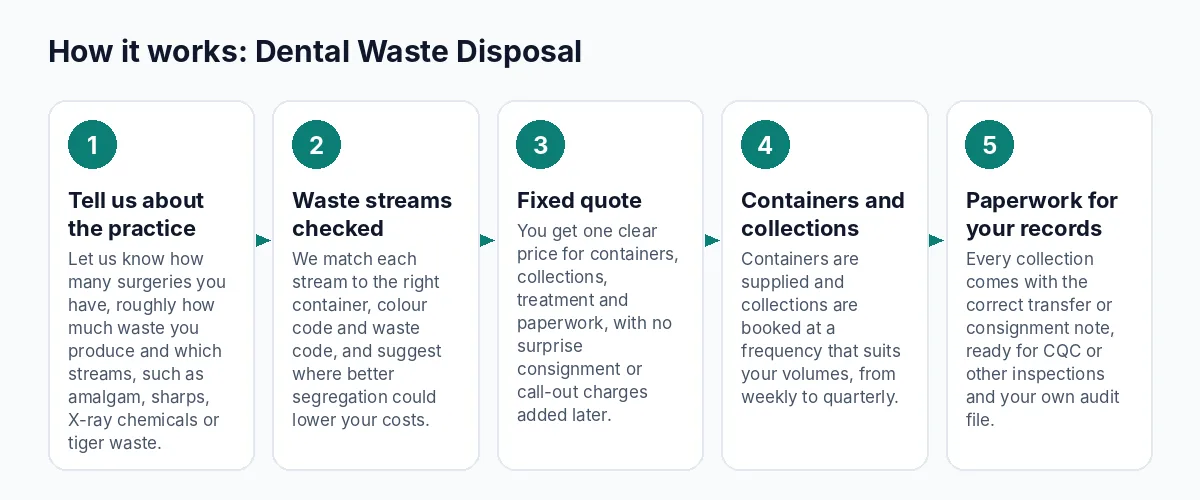
How it works

How dental sharps and anaesthetic cartridge disposal works, step by step
  1. Size the containers

    The number of surgeries and appointments is used to choose container sizes that fill in a sensible time.

  2. Place at the point of use

    Containers are positioned at each chair and in the decontamination room, within reach but out of patients' way.

  3. Close and store

    Containers are locked at the fill line, labelled and stored in a secure area ready for collection.

  4. Collect and record

    Full containers are collected on a regular schedule and the collection is recorded on the correct note for your file.

Dental sharps and anaesthetic cartridge disposal: FAQs

Why do part-used anaesthetic cartridges need a yellow lid?

Any cartridge with local anaesthetic left in it is contaminated with a medicine, which must be destroyed by incineration rather than lower-temperature treatment. Yellow-lidded containers go for incineration. Orange-lidded containers are for sharps with no medicinal contamination. Using yellow-lidded containers at every chair avoids mistakes when cartridges are in use throughout the day.

How full should a sharps container be before it is closed?

Close it when it reaches the marked fill line, which is normally around three quarters full. Overfilled containers are a common cause of needlestick injuries, because staff push sharps in or the lid will not lock properly. Many practices also replace containers on a fixed timescale, often every three months, even if they are not full.

What should be written on a sharps container label?

The label should show the practice name or address, the date the container was assembled and the date it was closed, and the initials of the person who did each. This lets the waste be traced to your practice and shows how long it was in use. Labels should be completed in permanent ink.

Can burs and matrix bands go in the sharps container?

Yes. Burs, files, matrix bands, scalpel blades, orthodontic wire and broken instruments are all sharps and should go in the sharps container, not in clinical bags where they could puncture the bag and injure someone. If they are contaminated with amalgam, they should go in the amalgam stream instead.

Get a quote for dental sharps and anaesthetic cartridge disposal

Send a few details and get one clear, fixed price, usually the same day.

Get a quote

Last updated 6 November 2026